
Juicer.Kitchen Verdict
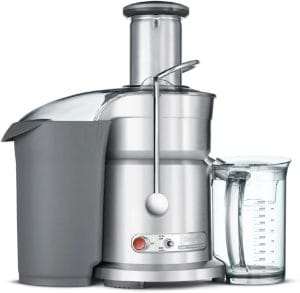
The Breville Juice Fountain Elite is our premium pick among centrifugal juicers — fast, powerful, and built with durability in mind. It can produce family-sized batches in seconds, and the 3-inch feed chute handles whole apples with minimal prep.
In our testing, it extracted more juice than several slow juicers from hard vegetables like carrots, delivered comparable yield on celery, and performed well with firm fruits such as apples and oranges.
That said, it struggles with leafy greens. While the juice is smooth and pulp-free, it isn’t as rich or dense as what you’ll get from a quality slow juicer. Internally, it uses the same centrifugal system found in Breville’s lower-priced models, so yield differences within the lineup are modest. If value is your main concern, the Breville Juice Fountain Cold offers similar performance for less.
Where the Elite justifies its higher price is in its stainless-steel construction, strong motor, and overall build quality. Cleanup is quick, parts are dishwasher-safe, and it has a solid, premium feel on the counter. It’s loud — like most centrifugal machines — but if speed and simplicity are your priorities, the Elite remains one of the strongest options in its category.Pros
Excellent for hard vegetables and firm fruits
Wide 3-inch feed chute
Stainless-steel construction
Produces juice in seconds
Very easy to assemble
Cons
Not ideal for juicing greens
Loud operation
Only 1-year warranty
Why You Can Trust Juicer.Kitchen: We’ve been reviewing juicers for more than 12 years and have influenced over $3M in juicer purchases. Every recommendation here is based on hands-on testing, not marketing claims.
Breville Juice Fountain Elite Detailed Review
Intro
The Breville Juice Fountain Elite is a top-tier centrifugal juicer that’s been on the market for a long time. It has been one of the bestselling juicer around the world and for a good reason. Its a heavy-duty juicer that gives near-commercial performance in a residential setting.
This juicer is best suited for people who value speed and simplicity. The wide feed chute minimizes prep, and juice is ready in seconds. It excels with hard vegetables and firm fruits like carrots, beets, apples, and oranges. Like all centrifugal juicers, it’s not designed for leafy greens or very soft fruits, but for fast, no-nonsense juicing, the Elite fits the role well.
Design & Build?
This is the classic centrifugal design you’ve probably seen in big-box stores. You drop the produce in, a high-speed blade micro-shreds it, and juice is pushed through fine holes in the stainless-steel screen while pulp is ejected to the side.
It is built mostly from stainless steel, with a plastic top cover. It is durable and looks impressive on the countertop, a clear step up from cheaper centrifugal models that are plastic.
A strong 1000-watt motor can handle just about anything. You also get a 1.1-quart juice jug with a froth separator and a large 3.2-quart pulp container, making it easy to juice larger batches in one go.
Is it a commercial juicer?
Despite its powerful motor and stainless-steel build, the Breville Juice Fountain Elite is not a commercial model. It’s designed for home use and does not carry any commercial certifications. That said, it’s easily one of the most powerful and durable centrifugal juicers you can buy for home kitchens.
How fast is it?
This is where the Elite truly shines. Drop produce in, and you have juice in seconds. It’s the fastest home juicer we’ve tested, and if time is your top consideration, it’s hard to beat.
To put it in perspective: if a fast juicer takes a minute to juice, a slow juicer might take 4–5 minutes for the same batch. Apples, pears, carrots — all processed almost instantly.
How to prep the produce
Thanks to the 3-inch feed chute, prep work is minimal. You can drop in whole small-sized apples or pears without cutting. It also handles entire bunches of celery or multiple carrots at once, saving plenty of prep time — especially when juicing larger batches.
Assembly
Assembly is one of the easiest parts of using the Breville Juice Fountain Elite — and honestly, that’s one of the biggest perks of centrifugal juicers in general. It’s almost intuitive, unlike many slow juicers that require a manual the first few times.
Here’s all it takes:
- Place the bowl on the base.
- Drop in the juicing screen.
- Fit the top cover
- Attach the pulp container, and clip it into place.
The machine also won’t run unless everything is properly locked, a simple but smart safety feature that prevents messy accidents
Juicing Performance (Our Tests)
We tested the Breville Juice Fountain Elite head-to-head against popular slow juicers — Omega Vertical, Omega Horizontal, and the Angel Twin Gear — using 2 lbs of each produce type. Below is what we found (see charts for yield and time comparisons).
Hard Vegetables – Carrots & Beets
This is where the Elite truly shines. The centrifugal design works exceptionally well on hard, root-textured produce — and it shows.
It powered through 2 lbs of carrots in under 40 seconds, producing more juice than any slow juicer except the twin-gear Angel. The juice came out airy but completely pulp-free.
Slow juicers, especially vertical and single-auger types, don’t grind carrot pulp as finely, resulting in about 10–30% less yield on hard vegetables.
Twin-gear juicers like the Angel or Greenstar can squeeze out more juice and make higher-quality juice, but they take 3–4 times longer, require more effort to feed carrots, and cost significantly more.
If your main goal is making carrot or beet juice, we’d pick the Breville. It’s easy to use, produces an excellent yield, and delivers fresh juice in seconds — loud, yes, and slightly more oxidized, but for many people, that’s a fair trade.
Watery Vegetables – Celery
Breville elite powered through 2 lbs of celery in just 30 seconds, delivering yield close to slow juicers. The Angel Juicer extracted slightly more as expected.
In horizontal slow juicers, you can feed whole stalks, while vertical ones need celery cut into smaller pieces to prevent clogging. The Elite? We fed entire bunches at once — juice came out almost instantly.
The juice was clear, though a bit foamy. Thanks to celery’s high water content, this style actually works great for it — fast, simple, and surprisingly efficient.
Fruits – Oranges, Apples, Grapes, Pineapple
Oranges: For firm oranges, the yield was about the same as slow juicers. The juice came out pulp-free, but a bit airy and less flavorful. Slow juicers, on the other hand, produced richer-tasting juice with deeper color and small bits of pulp.
Apples: The Elite performs fairly well with apples. It made about 20% less juice than slow juicers. Breville’s juice was light, much like store-bought apple juice. Slow juicer juice was very flavorful and richer in consistency.
Grapes: The Breville Juice Fountain Elite juiced 2 lbs grapes in under 40 seconds as expected. It produced less juice and wetter pulp compared to slow or twin-gear juicers. At high speed, grapes can bounce back on face, so use the pusher quickly to keep everything contained.
Pineapple & Soft Citrus: For ripe pineapple or tangerines, the Elite’s yield was about 30–45% lower than slow juicers, and the pulp came out quite wet. It’s not ideal for very soft produce.
If your focus is mostly fruits, a vertical slow juicer like the Hurom H400 tends to deliver better yield and richer juice.
Leafy Greens
Greens Juicing Test – 2 lbs Greens
This is where centrifugal juicers like the Elite show their weakness. It managed to juice 2 lbs of greens in under 3 minutes — incredibly fast — but the yield was nearly half of what we got from slow juicers.
If leafy greens are your main focus, a slow juicer like the Omega NC800 or a twin-gear model will serve you much better. But if greens are only a small part of your mix, the Elite’s speed and simplicity make it a great contender.
Overall Performance Summary
Best for: Hard vegetables, firm fruits, high-volume juicing.
Not ideal for: Leafy greens, soft fruits prone to aeration.
Juice quality: Smooth and nearly pulp-free, though slightly oxidized from high-speed spinning.
Time efficiency: Juice in seconds.
Bottom line:
If you primarily juice carrots, beets, celery, apples, or other firm produce — and want juice in seconds — the Breville Juice Fountain Elite is an excellent fit. It’s quick, requires minimal prep, and delivers great yields for hard produce.
If your goal is leafy greens or higher quality juice, consider a slow juicer.
Noise?
One of the main downsides of centrifugal machines is they are loud — about 81 dB. Comparable to a high-speed blender. Not ideal for early mornings if anyone’s sleeping nearby.
Cleaning?
In our tests, it took about 2 minutes to clean. The mesh screen takes the most time — lots of fine holes to scrub — but overall, cleanup is quick. But be careful when cleaning the blade and screen — the micro-blades are razor-sharp and can easily cut your fingers. Always use the included brush, not a sponge (it’ll shred instantly).
Warranty?
Breville offers just a 1-year warranty, which is short compared to the 10–15 years offered by most quality slow juicers. We would have liked to see a longer warranty at this price point. That said, the Elite’s stainless-steel construction is solid and well engineered — reassuring, even if the coverage period is shorter. In our experience, we’ve seen these machines continue running reliably for many years without major issues.
Multifunctional Capabilities
Elite is purely a juicer — no nut butters, sorbets, or pasta extrusions like some slow juicers.
Final words
The Elite is top-tier for centrifugal juicers. It features a higher motor wattage and a stainless-steel body instead of the polymer build found in lower-priced Breville models like the Compact or Cold. The underlying technology is the same centrifugal system, so yield isn’t drastically different from those models. If you’re looking for pure value, the Breville Juice Fountain Cold delivers similar results for less.
That said, if design, durability, and a more premium feel matter to you, the Elite stands apart. For anyone who wants fresh juice from fruits and vegetables in seconds — and understands the typical centrifugal trade-offs with greens and foam — it’s a solid, heavy-duty machine built for everyday use.

Leave a Comment